How Do Triangular Currency Calculations Maintain Consistent Exchange Rates?
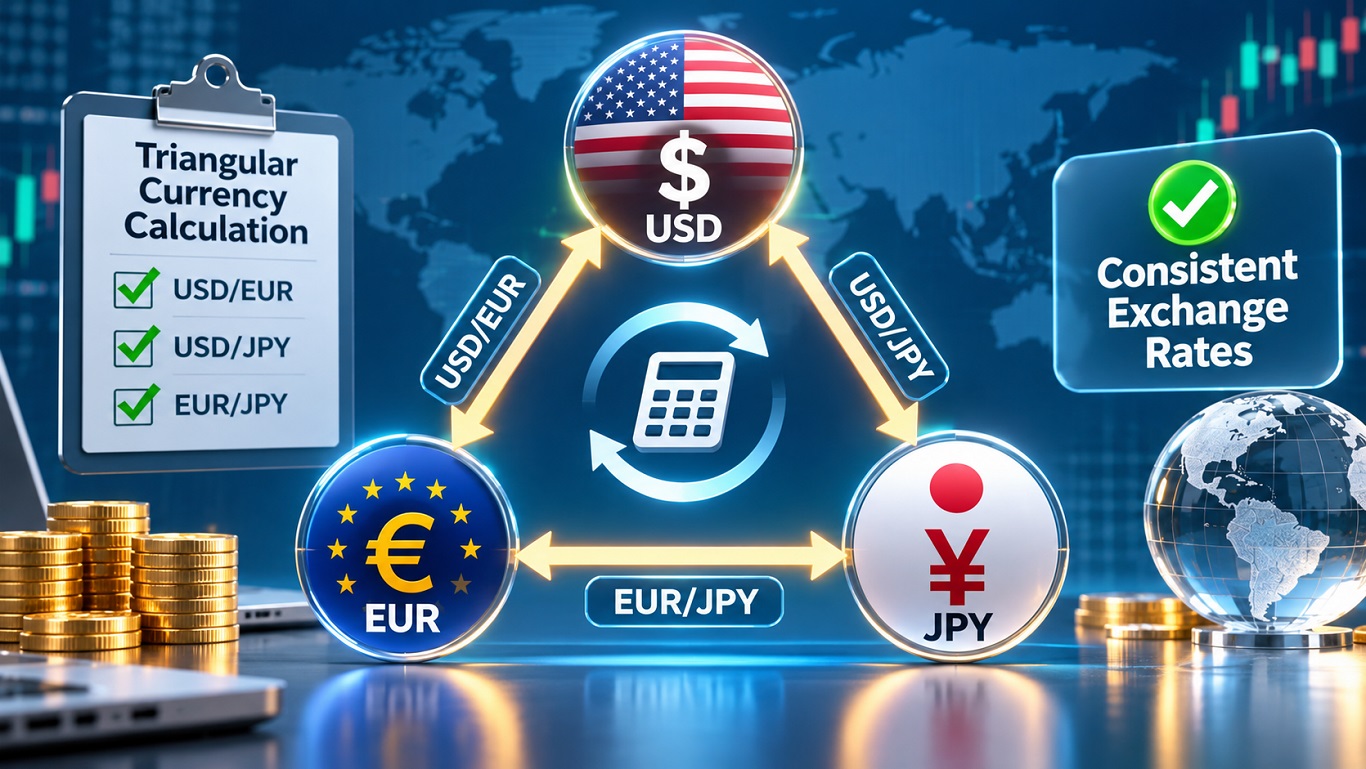
Three exchange rates connecting three currencies cannot move independently forever. If the price of one currency implied by two other pairs differs from its direct quotation, dealers can compare the routes and, where executable prices permit, trade away the discrepancy. The arithmetic is simple; obtaining three compatible prices at the same instant is not.
For anyone asking what is forex trading, triangular calculations explain how cross rates remain broadly aligned across markets. They also expose five ways a currency CFD can behave differently from a seemingly precise conversion formula.
Midpoint Calculations Can Invent a Profit That Cannot Be Traded
Take EUR/USD at 1.1000 and USD/JPY at 150.00. Multiplying gives an implied EUR/JPY midpoint of 165.00. A direct EUR/JPY quote at 165.05 might appear to offer a five-sen discrepancy, but midpoints are not executable transaction prices.
A real three-leg conversion must use the appropriate bid or ask on every leg. Spreads can consume the apparent difference before commissions are considered. Compare simultaneous two-sided quotes, not chart closing values, when assessing whether a cross rate is genuinely inconsistent.
Asynchronous Quotes Can Turn Arithmetic Into Execution Loss
Currency feeds update at different frequencies. A cross calculated from a fresh dollar-yen quote and a stale euro-dollar quote may show an opportunity that disappeared milliseconds earlier. During thin trading or a sudden repricing, even correctly calculated indicative rates can be unusable.
Imagine a hypothetical EUR/JPY CFD quoted at 165.10 when EUR/USD is 1.1000 and USD/JPY is 150.00, implying 165.00. A trader sells a CFD representing EUR 20,000 at 165.10, expecting the direct cross to converge downward. Instead, USD/JPY rises to 150.20 while EUR/USD holds at 1.1000, moving the implied cross to 165.22. The CFD is closed at 165.25, a loss of JPY 3,000, calculated as 0.15 yen times EUR 20,000, before charges.
The earlier discrepancy did not guarantee convergence toward the original midpoint. Check quote timestamps, dealing spreads and execution rules before relying on a three-rate comparison.
Shared Currency Legs Can Create Hidden Portfolio Concentration
Triangular relationships also reveal exposure duplication. Long EUR/JPY, long EUR/USD and short USD/JPY positions are not three unrelated views: the first pair approximately combines the latter two directional exposures. Their sensitivities differ with position size and exchange rates, so equal CFD contract counts do not automatically offset.
A portfolio may look diversified by instrument name while retaining a substantial common euro or yen exposure. Translate each position into currency notionals and calculate aggregate sensitivity before adding a cross-pair trade.
Provider Pricing Can Diverge From an Interbank Cross
A CFD provider may derive cross-pair prices from external feeds, apply a spread adjustment or use different liquidity sources across instruments. During market interruptions, its displayed EUR/JPY price may not equal the multiplication of its own EUR/USD and USD/JPY midpoints.
An apparent inconsistency therefore need not be an arbitrage opportunity accessible through that account. Contract specifications, quote conventions and rejection policies determine which prices can actually be traded. A platform’s indicative chart is not a promise to execute three simultaneous legs.
Three-Leg Trades Can Accumulate Costs Even When Rates Align
In what is forex trading discussions, triangular arbitrage is often presented as a near-riskless identity. The identity governs consistent exchange rates, not the cost of holding CFDs. Separate legs can incur spreads, overnight financing and margin requirements, while an unsuccessful partial execution leaves an unintended currency position.
A perfectly consistent set of exchange rates can therefore still produce a loss after trading costs. Before opening a cross-currency CFD, calculate its implied rate using synchronized executable bid and ask quotes, map overlapping currency exposures, and confirm the provider’s spread, financing and margin treatment.





Post Comment